

Work Completed
As mentioned in the January Update, you will be aware that the Hornblocks have been cast at the premises of William Cook Cast Products in Sheffield. They have now been released and delivered to our construction site at CTL Seal in Sheffield, where they will be machined and fitted to the chassis.
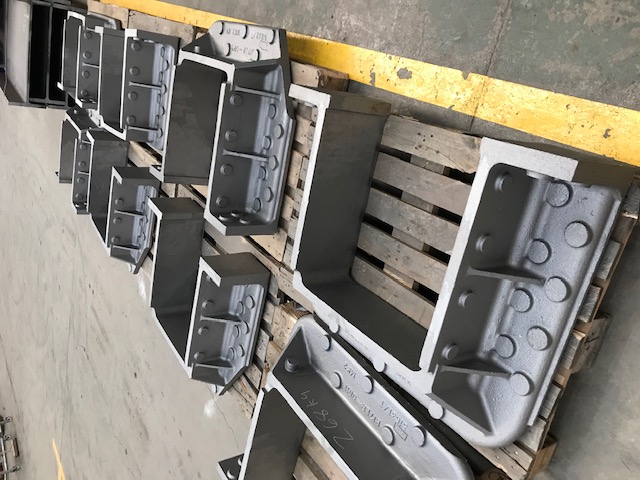
In the meantime, the patterns for the Cannon Axle box and the Coupled Axles are being prepared for delivery to William Cook's, where these items will be cast.
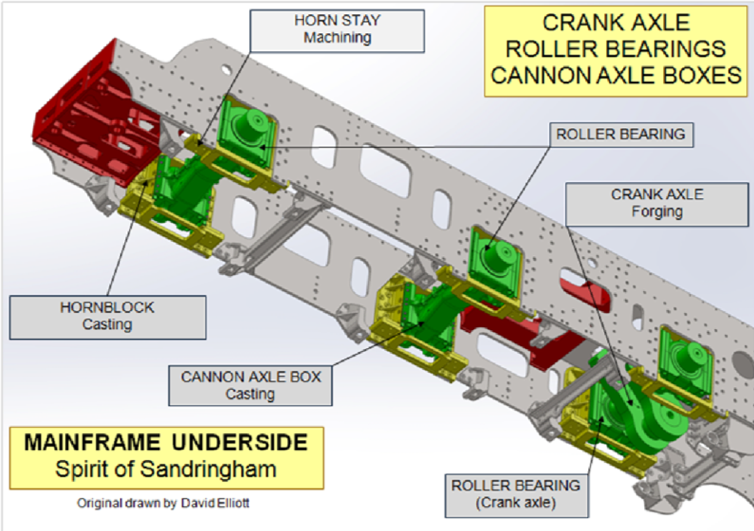
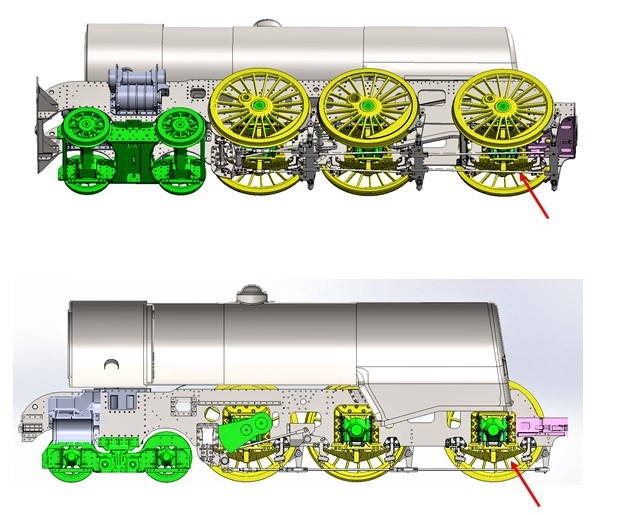
It is possible some members will not be sure exactly where these castings go on the locomotive so hopefully the diagram below gives some clarification. The hornblocks are shown in yellow.
The Next Castings
With the kind permission and help of the A1 Steam Locomotive Trust and William Cook Cast Products, arrangements are being planned to prepare the existing patterns for the Coupled Axleboxes and Cannon Axle boxes to be transported from storage in Darlington “Loco Works” to Sheffield. However, the pattern for the coupled wheel used for Tornado remains on display in the “Head of Steam” Museum at North Road Station, Darlington. Public access to the museum is severely restricted meaning that our ability to remove the pattern is likely to be delayed until a relaxation in restrictions is introduced and access is granted by the Local Authority (Darlington Borough Council). Pattern recovery will involve members of the A1 SLT and B17 SLT, to be conducted when Covid infection rates are low and a safer working environment is more certain and appropriate permission received.
ENGINEERING DEVELOPMENT
Inside Cylinder
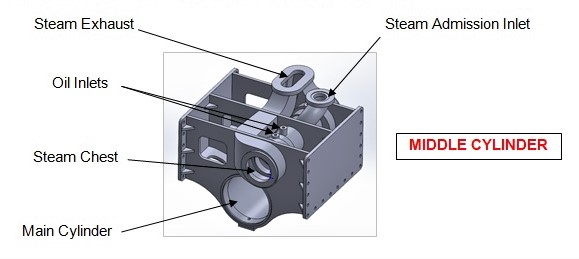
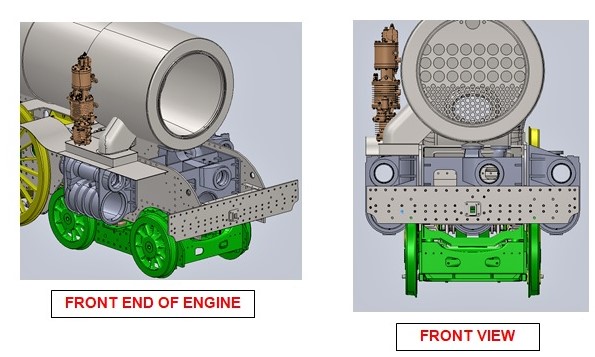
The shape of the inside cylinder is similar to that of the outside cylinders but its location, fitted between the frames, is much further forward, situated above the front bogie axle shown on the illustration of the front end of the engine. The off-set of the steam chest towards the left hand side of the engine (when facing forward) is clearly visible on the front view. Detailed design work on all three cylinders will be combined to produce fabricated structures using appropriate welding techniques and materials providing greater strength compared with traditional castings. CAD technology will be used to define the complex set of fabricated shapes as discrete sub-assemblies and the order of integration to build up each cylinder structure, which in turn will define the sequential stages of assembly. This will deliver significant savings in pattern design and manufacturing costs that would otherwise be required for each of the three cylinders in turn. The fabricated design of the saddle will follow.
Springs
The revised design of the main leaf springs (arrowed) can be seen on the right hand side of the engine shown tilted in the top view and the section through the frame structure lower view.
Detail drawings are currently being reviewed by Owen Springs Ltd of Rotherham to provide their quotation. This company are experts in their field for the heritage sector, having acquired much of the manufacturing kit, test equipment and technical data including drawings and material specifications from the former BR Workshops at Eastleigh and Derby, upon their closure in the 1960s. Doubtless a real set of gems!
We are most grateful to Alan Parkin and David Elliott, who jointly provide the engineering design expertise in researching and producing the 3D illustrations and component drawings using the Solidworks system for the cylinders and springs.
SO TO SUMMARISE, WHAT’S NEXT IN 2021?
Once we have the patterns from Darlington and the quotations from CTL Seal, the Trust can move forward with:
- Machining and fitting the hornblocks (these will shortly be moved from William Cook’s premises to those of CTL Seal). Includes the manufacture of hornblock linings.
- Set up of the frame structure to conduct straightness and measurement checks (using laser based equipment).
In the meantime the Trust will, as soon as the Coronavirus restrictions allow:
- Move the cannonbox and the coupled axlebox patterns from their location at the A1 Steam Locomotive Trust’s premises in Darlington, to William Cook’s in Sheffield and cast.
- Similarly, move the wheel pattern from storage at the Museum in Darlington, to William Cook’s premises and cast.
Once cast and released, the next tasks are:
- Machining and fitting the cannonbox and coupled axlebox castings.
- Manufacturing horn stays.
All of the above is achievable in 2021 but dependent on both the lifting of movement restrictions and funding. In the meantime, detailed design work will continue.